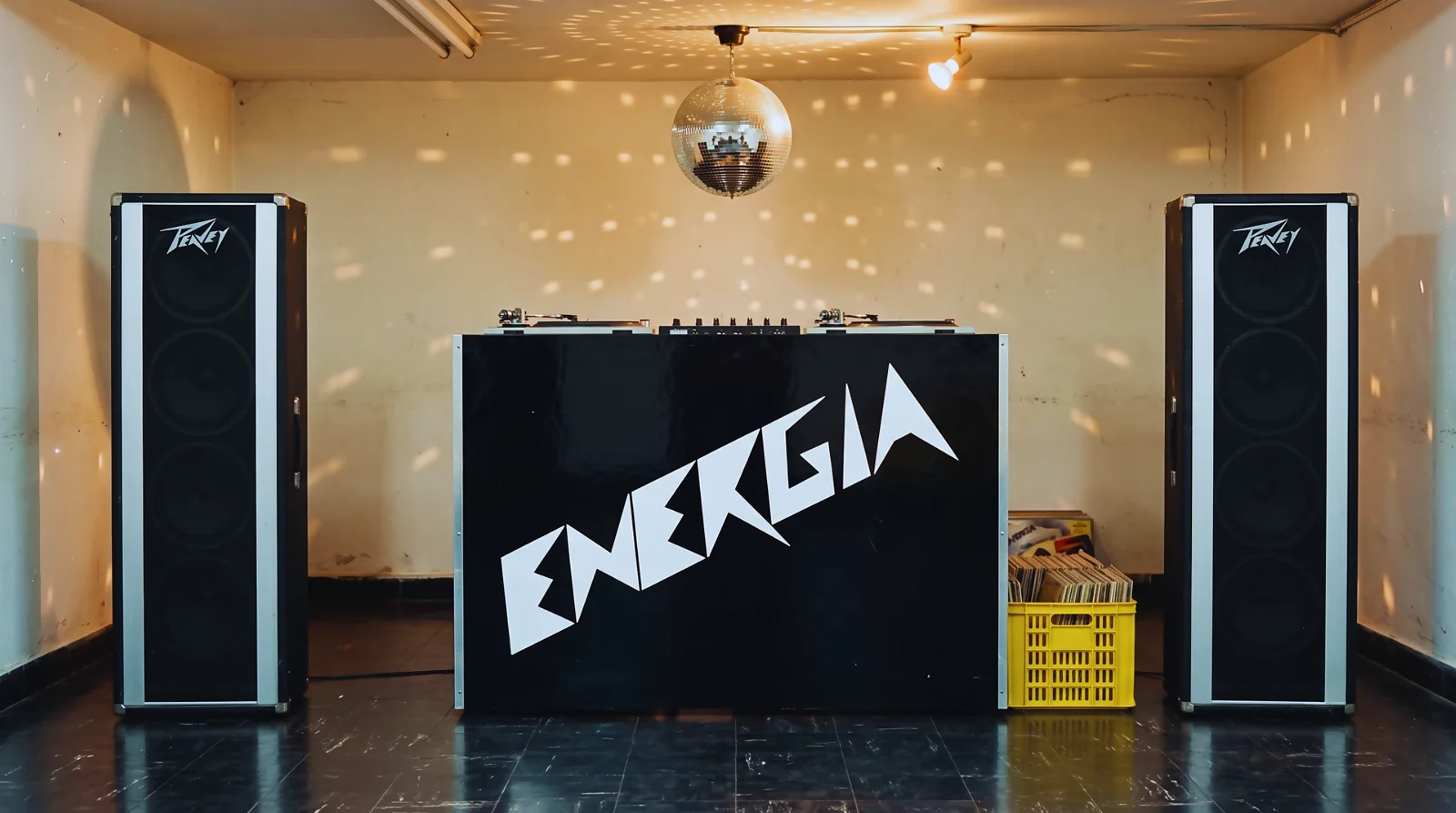
The trait Energía is remembered for is its elegance. It was not a miniteca of stridency but of style: it was booked mainly in the Los Olivos and Alta Vista neighborhoods of Puerto Ordaz, at parties where class mattered as much as volume.
The rig and the booth
Energía's sound was built on Technics turntables and a Pioneer mixer: the base with which those teenagers crossed the line between the homemade rig and event sound. Those were years when the playing of the discjockeys was still very green in the region, and the challenge was twofold, because the mixer had no booth monitoring for cueing and chaining the mixes with precision: spinning clean, under those conditions, was a feat.
Carlos Simoza and Carlos Rojas took turns in the booth, the miniteca's discjockeys. The set they prepared was not improvised: it recreated, track by track, the mixes of the first volume of the “City Hall” series (Beta Record, 1979) —the mixed records that came out of the Caracas discotheque City Hall, in the Centro Ciudad Comercial Tamanaco, whose resident disc jockey was Francisco “Paco” Lorenzo (see the City Hall Discotheque entry in Legendary Discotheques)—. Reproducing that chain on stage, with a mixer without monitoring, was exactly the kind of demand that separated a careful miniteca from the rest.
The La Hostería sound clash and the sabotage
The first guerra de minitecas —the sound clashes of the movement— at Club La Hostería put that booth work to the test. Hot Music won that confrontation —its own article records it too— but the first-hand account adds a detail the chronicles did not carry: Energía's equipment was sabotaged by filling its mixer with water. Losing under those conditions does not erase the fact that matters: Energía was in the front line of the Guayana circuit when the movement was taking shape, with a masterfully prepared set and the ambition to sound like the records of the day.
1980: the merger with Infierno Sweet
Energía lasted around two years. In 1980, its members joined forces —merged— with Gregorio “Goyito” Bello's miniteca Infierno Sweet: the famous one “del cerrito” of Puerto Ordaz, remembered to this day for a rig of imposing presence and for the use of four turntables in action. Out of that union came the crew that, already as part of Infierno Sweet, would end up joining Hot Music in 1984 —Enrique Rojas, Carlos Luis Valenzuela and Carlos Simoza— to give “La Number One” the leap in quality that made its name in eastern Venezuela.
So the story of Energía does not close with the disappearance of the name, but continues in two other entries of the Archive: that of Infierno Sweet, currently in production, and that of Hot Music, where its people were the driving force. The “Goyito” Bello entry, in Hidden Figures, completes the other corner of this merger.
What the Archive is still looking for
Still to be confirmed are the exact year in which Star Cruiser turned into Energía, the precise date on which it stopped performing under that name, and photographs of the miniteca —the local photographic archive of La Revista de las Minitecas has, to this day, no folder under its name—. If you belonged to Energía or to Star Cruiser, booked it in Los Olivos or Alta Vista, or keep photographs and material, contribute to the MiniTK Archive: the CulturaMiniteka community wants to complete its story without assuming.
Social media
- · Social media and contact: still being traced — do you have information? Write to us through the contact form
Credits and sources
- · First-hand account gathered by the CMTK Archive (2026-07-10) — primary source: Energía was born as Star Cruiser (a homemade miniteca) and was founded in Puerto Ordaz by four friends of ~15 —Carlos Luis Valenzuela, Enrique Rojas, Carlos Rojas (Enrique's brother, music supplier from Valencia, Carabobo) and Carlos Simoza—; elegant style, booked in Los Olivos and Alta Vista; Technics equipment (turntables) and Pioneer (mixer, with no booth monitoring); discjockeys Carlos Simoza and Carlos Rojas; in the 1st sound clash at La Hostería (won by Hot Music) its mixer was sabotaged with water; its set recreated the mixes of the first City Hall record; it lasted ~2 years and in 1980 it merged with Gregorio “Goyito” Bello's Infierno Sweet (“la del cerrito,” imposing rig, four turntables).
- · Internal cross-reference within the Archive — Hot Music entry (migrated from the original culturaminiteka.com article, ★★★★): the Club La Hostería sound clash in 1980 won by Hot Music; the 1984 arrival at Hot Music of Energía's founders, by that year members of Infierno Sweet (Enrique Rojas, Carlos Luis Valenzuela, Carlos Simoza); the retirement of Rojas and that crew at the end of 1986.
- · External research on City Hall (WebSearch + Discogs + specialist blogs, July 2026, ★★★☆☆): the City Hall discotheque (Centro Ciudad Comercial Tamanaco, Caracas, opened on 17 March 1979) had Francisco “Paco” Lorenzo as its resident disc jockey; its label Beta Record released the “City Hall” series of mixed LPs from 1979 (vol. II, LPBTV 2001, in 1980). The disc jockey who signed the mix of the FIRST volume does not appear credited in the sources consulted (Discogs lists no mixing credit): it remains TO BE CONFIRMED and is not attributed.
Were you part of the crew, or did you witness their setups? Help us document this story with verified facts and images.
Tell us and help improve this entry