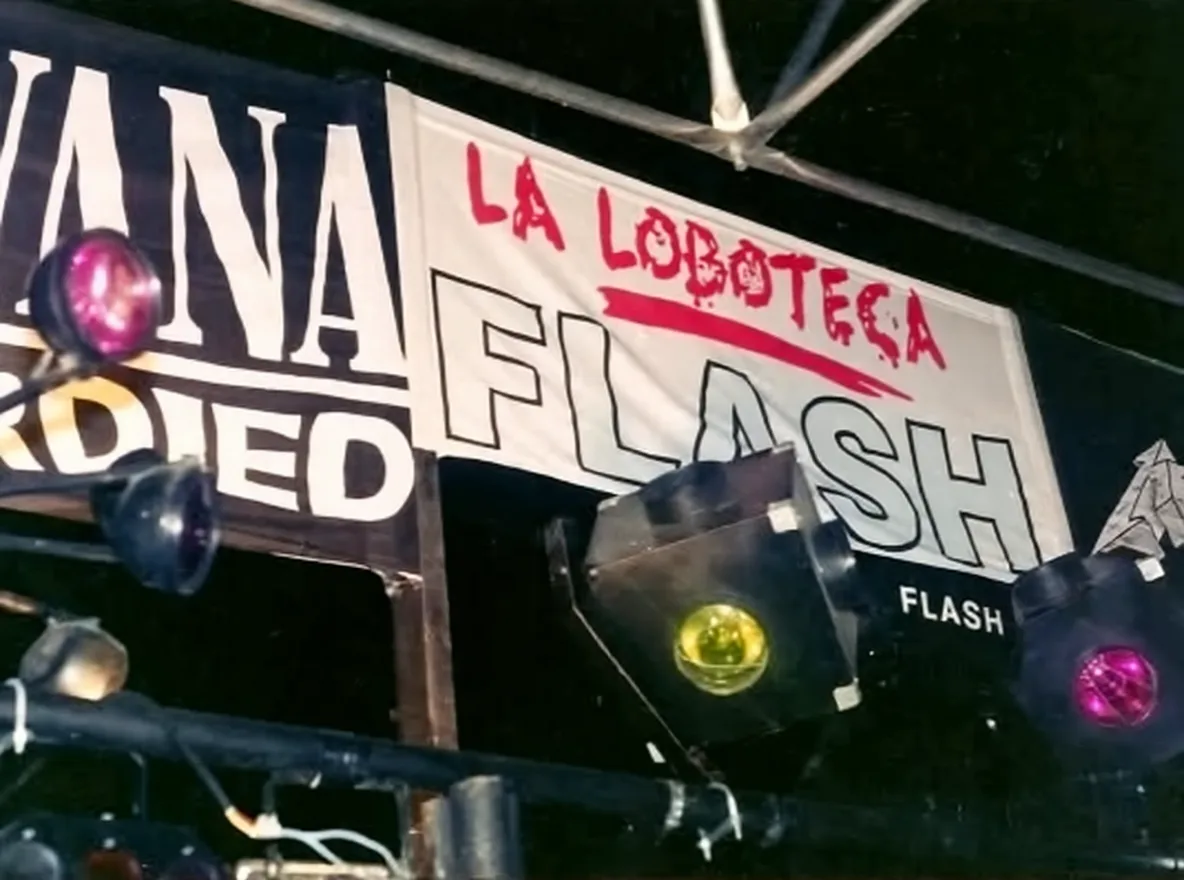
Main photograph: archive of culturaminiteka.com · Additional photos: archive of La Revista de las Minitecas (DJ Vladimir Medina)
◆ Miniteca · Mobile Power
Loboteca Flash
El Aullido del Lobo
Welcome to the official page in honor of the authentic Miniteca Loboteca Flash, one of the most original and innovative in Valencia between the 80s and the 90s.
In search of the sound of Loboteca Flash
We are working to track down genuine Loboteca Flash sets in the best possible audio quality. If you keep a cassette, a mix or a jingle, share it through the contact form.
The beginnings
The story of Loboteca Flash begins in 1987, in Valencia (state of Carabobo), as the dream of two young brothers: Gustavo Valera and Javier Valera, who at just 13 and 11 years old decided to form their own miniteca and called it Flash.
They did not have enough money to take their first steps, but in time those two boys made their dream come true. They started out with home equipment —the misnamed “3 en 1” sets, old turntables picked up here and there and a mixer from the 60s with dirty potentiometers—. In 1991 they got their first power amplifier, a QSC USA 1300, and the following year they made the leap to a more professional line with Carver gear, RCF bass bins, Peavey horns and their first MKII 1200 turntables.
The name: from the wolf and from Flash Gordon
It was in 1993 that they decided to call it Loboteca Flash. The name was born from the joining of two references: “Loboteca” came from a program broadcast by the station La Mega Estación, titled “La Cueva del Lobo”; and “Flash,” its original name, came from the series Flash Gordon.
Its first appearance under that name was at a concert in Valencia called La Lobo Rumba, alongside Desorden Público and Monaguillos de Sodoma. It was there that the unmistakable howl of the wolf was heard for the first time.
Sound, lights and a show out of the movies
Loboteca Flash stood out for a cutting-edge technical proposition. They were among the first to have 1500 W RCF bass bins in Turbosound. After the era of the “arañas” and the “dobles cubos,” in 1994 their lighting was always automated: they went through the Robotscans and the whole Martin line, up to the MAC 2000s. By the middle of 1997 they had twelve giant video screens.
But what made them unforgettable was the spectacle. They combined a programmed show with special effects and a performance troupe that gripped the spectator: platforms on hydraulic lifts for the emcees, fire jugglers, acrobats and, as their particular signature, two guitarists on stage accompanying the mixes live. A video jay projected thousands of images around the music.
Mystery, rumor and exclusivity
What made Loboteca Flash so special? They never took part in a guerra de minitecas, the sound clashes of the movement. They operated in a different way and won the public over with a carefully worked marketing strategy aimed at a selective audience. They studied each town in depth and started spreading rumors: people would murmur about “some Loboteca or other” that threw spectacular parties in far-off, exclusive places. Once the rumor was well spread, the final blow arrived: the radio advertising.
That way, people grew desperate to buy tickets and see the show.
«Believe it or not! Here comes the phenomenon that draws crowds. After its show with Molotov, and for one time only, la Loboteca Flash will be in concert, and you cannot miss it, because it will not happen again.»
The booth and the voices
Loboteca Flash's lead DJ was always Javier Valera, better known as DJ Z —after Mazinger Z, whose comic they always projected at the parties—. He was joined by the video jay Nallira, known as Afrodita, in allusion to Mazinger Z's girlfriend.
La Loboteca's official voices were two young women: Neila Fuentes, of a very sensual voice —an opera singer who sang in the chorus alongside Pavarotti—, and Michelle Taffin, daughter of their friend Petter Taffin, owner of Rumbera, whose youthful voice brought freshness to the jingles.
Its sponsors were the stations La Mega Estación and Rumbera Network, the MTV channel —which sent them greetings with its presenters— and Empresas Polar, one of its most faithful collaborators.
Memorable anniversaries
Loboteca Flash celebrated its anniversaries by inviting numerous artists:
· 6th Anniversary — At the Forum de Valencia, with Molotov, Control Machete and The Noise. 23,000 people attended, counted by the Alcaldía de Valencia.
· 7th Anniversary — Held in two cities, Maracay and Valencia, with King Changó and the group Malanga.
· 8th Anniversary — With Genitallica and King Changó as guests.
Shared stages and tours
Loboteca Flash took part in thousands of events and shared the stage with big names: Café Tacuba, Shakira, Maná, UB40, Los Pericos, Los Amigos Invisibles, Caramelos de Cianuro and Los Enanitos Verdes, among others. They also toured Venezuela under the name “La Loboteca Flash y sus amigos,” where they played with Guaco, La Corte, Calle Ciega, Los Amigos Invisibles and Desorden Público.
An anecdote: a plane full of stars
One of the anecdotes most often told by the crew happened during the “La Loboteca y sus amigos” tour: they were playing on a Friday in Puerto La Cruz and on the Saturday in Barquisimeto. To honor both contracts they chartered a private plane, big enough to move all the show's equipment. And onto that same plane they piled Los Amigos Invisibles, La Corte and Desorden Público. Imagine the commotion that broke out on board: it was the only way to get there in time.
From la Loboteca to La Elite Flash
Loboteca Flash worked with a modular rig that scaled from private parties to macro-concerts. They never split the miniteca to perform in two places at once: when someone booked it, no one else could book it simultaneously —another form of exclusivity—. They would usually arrive two days early to build the stage without rushing, with a technical staff of ten people treated as one big family.
In time, la Loboteca grew so much that it became a live-events production company and left the name Loboteca Flash behind. Today that company is called La Elite Flash, run by Gustavo Valera, and according to the account of its protagonists it came to have the largest lighting roof in Venezuela.
His brother Javier Valera, always passionate about film, made a movie titled “Después del Túnel,” and from there took the decision to move to Spain to devote himself to film and television. Javier married Nallira, the video jay, who graduated as a dentist and today is with him in Spain supporting his audiovisual productions.
· Article based on the account of its protagonists collected in La Revista de las Minitecas (DJ Vladimir Medina edition), cross-checked against period publications and the memory of the miniteca community.
· Pending documentary verification: the title and the credits of Javier Valera's film, as well as the exact dates of each anniversary.
Were you part of the crew, or did you witness their setups? Help us document this story with verified facts and images.