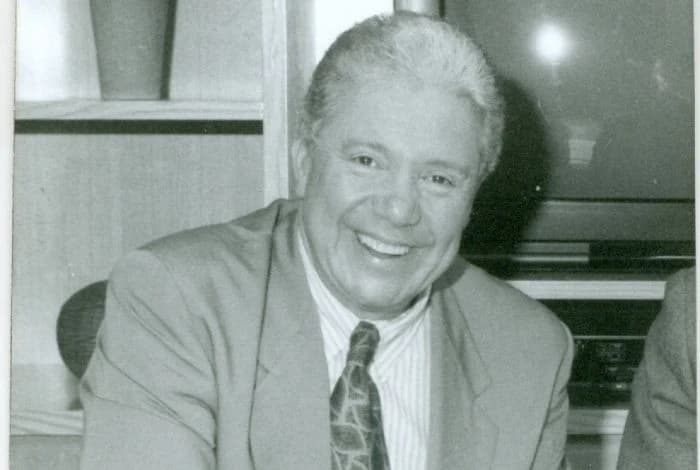
The actor before the host
In 1963 the producer Héctor Monteverde hired him for the telenovela “Historia de tres hermanas,” where he shared the screen with Raúl Amundaray, Eva Moreno and Doris Wells. Then came “El derecho de nacer” and “La usurpadora,” along with the dramas RCTV broadcast under the “Novela Camay” and “La Novela Palmolive” labels.
He went international early: he moved to Mexico, where he worked for two years at Tele Sistemas Mexicanos — the future Televisa — became friends with Emilio Azcárraga Vidaurreta and with the director Alfonso Arau, and received in 1967 the award for Best Prospect Actor. Back in Venezuela he produced, wrote, directed and acted in RCTV drama slots, and became a theater impresario: he bought the Teatro Chacaíto I in 1974 and opened the Chacaíto II in 1977, the two most important commercial houses of Venezuelan comedy, where for a decade he signed off on almost everything that was staged.
1976: “Viva la Juventud”
That year RCTV chose him to host “Viva la Juventud,” a contest for secondary school students. It was his debut as a host and the beginning of the side of him the whole country would come to recognize. At the front he was accompanied first by the singer Raquel Castaños and later by Carmen Victoria Pérez — the duo portrayed in the photograph of the “Libretas de la Juventud.”
For this Archive, that program matters for what it let people see: it was one of the first television showcases of the miniteca movement, a youth show with national reach in which the music and the mobile sound of the street reached the studio floor.
1979: “Fantástico,” and out of it “La Linoteca”
In 1979 he premiered “Fantástico,” the marathon Saturday variety show that carried his nickname and that he hosted with Neyda Plessman to compete with Venevisión's “Sábado Sensacional.” Inside “Fantástico,” the segment “Cuánto Vale el Show” was born in 1980, the amateur contest before a panel of judges through which — according to his biographical profile — José Luis Rodríguez “El Puma,” Oscar D'León and Menudo passed.
And inside “Fantástico” there also lived the “Ranking Musical Fantástico,” the youth segment that later came to be called “La Linoteca” and that set up, week after week on its studio floor, the best minitecas in the country. There lies the fact that ties him to this story: the movement's two television showcases — “Viva la Juventud” and “La Linoteca” — came from the same hand. The stage where New York New York, ZC, Sandy Lane, Best Music or Betelgeuse showed their booths was, in origin, his program.
The businessman: channels and fifteen stations
When his time at RCTV came to an end he founded Televen and his own production company, Televicentro, with which he made “El Show de Fantástico,” the children's telenovela “Crecer con papá” and the youth program “Juventud Fantástica” for Venezolana de Televisión. He came into Televen as vice president of Production and Sales with 50% of the shares — the other 50% belonged to Alberto Federico Ravell — a partnership later joined by Omar Camero Zamora, Arturo Pérez Briceño and Alfonso Riveroll; three years on he sold his stake to Camero Zamora.
He then went to Maracaibo, where he founded Televiza Canal 7 with the businessman Calixto Rocca and created fifteen radio stations: Fantástica FM, Ondas del Lago FM and AM, Sol AM, Fabulosa Stereo, Romántica, Favorita Stereo, Muselca Stereo, Radio Cabimas and Super K la Karibeña, in Porlamar. In April 2002 he asked Conatel to convert the administrative license of Super K; the refusal ended up closing the station. In Margarita he was a shareholder and director of Banco Insular, which he sold four years later.
“Cuánto Vale el Show” went its own way as an independent program: between 1993 and 1996 on RCTV and between 1998 and 2001 on Venevisión, the channel where he also made “La Gran Boloña” (2005-2006). He later advised on the creation of television channels in Peru, Colombia, Chile, the Dominican Republic and Miami, and in 2013 he announced on Globovisión a channel of his own, CNT, which never came to be.
The style and the farewell
He deliberately broke with the solemnity of the classic presenter: he brought in an informal tone and a handful of phrases that stuck to his name. He greeted his audience with “¿qué tal, mis queridos caramelos tropicales / apreciadas fieras?”, he was known above all as “Rolo 'e vivo,” and he always signed off the same way: “Vayan con Dios, pero regresen…”.
A bullfighting enthusiast, he sponsored toreros such as Leonardo Benítez, and hosted events such as the “Chica 2001” contest of 1984 on RCTV and the “El Disco de Oro” awards ceremony of the music industry. He had one son, Bader González.
A declared opponent of Hugo Chávez's government, he left Venezuela and settled in Madrid, from where he continued to run his communications companies. In December 2019 he was diagnosed with liver cancer and he died on June 30, 2020, at the age of seventy-five, in the Spanish capital.
Credits and sources
- · Full biography — birth in Las Palmas de Gran Canaria (June 8, 1945) and arrival in Venezuela at the age of seven; secondary school in 1963 and architecture at the UCV; Juana Sujo's scholarship after seeing him with Cherry Navarro; theater debut in 1962 and television debut in 1963 with Héctor Monteverde; his time at Tele Sistemas Mexicanos and the Best Prospect Actor award (1967); the Chacaíto I (1974) and II (1977) theaters; “Viva la Juventud” (1976) with Raquel Castaños and Carmen Victoria Pérez; “Fantástico” (1979) with Neyda Plessman and the birth of “Cuánto Vale el Show” (1980); Televen, Televicentro, Televiza Canal 7 and the fifteen radio stations; Banco Insular; “Cuánto Vale el Show” on RCTV (1993-1996) and Venevisión (1998-2001); “La Gran Boloña” (2005-2006); his catchphrases; his son Bader González; the exile in Madrid, the December 2019 diagnosis and his death on June 30, 2020: Wikipedia in Spanish, “Guillermo González Regalado.” Accessed July 31, 2026.
- · His standing as initiator and lead host of “Viva la Juventud”: primary source of the CMTK Archive, corroborated by the RCTV schedule card announcing the program with Carmen Victoria Pérez and Guillermo González.
- · Relationship with the minitecas: the entries for “Viva la Juventud” and “La Linoteca” — the youth segment of his Saturday show “Fantástico” — in the Allies On Air collection of this Archive.
- · Photographs contributed to the CMTK Archive.
Were you part of the crew, or did you witness their setups? Help us document this story with verified facts and images.
Tell us and help improve this entry