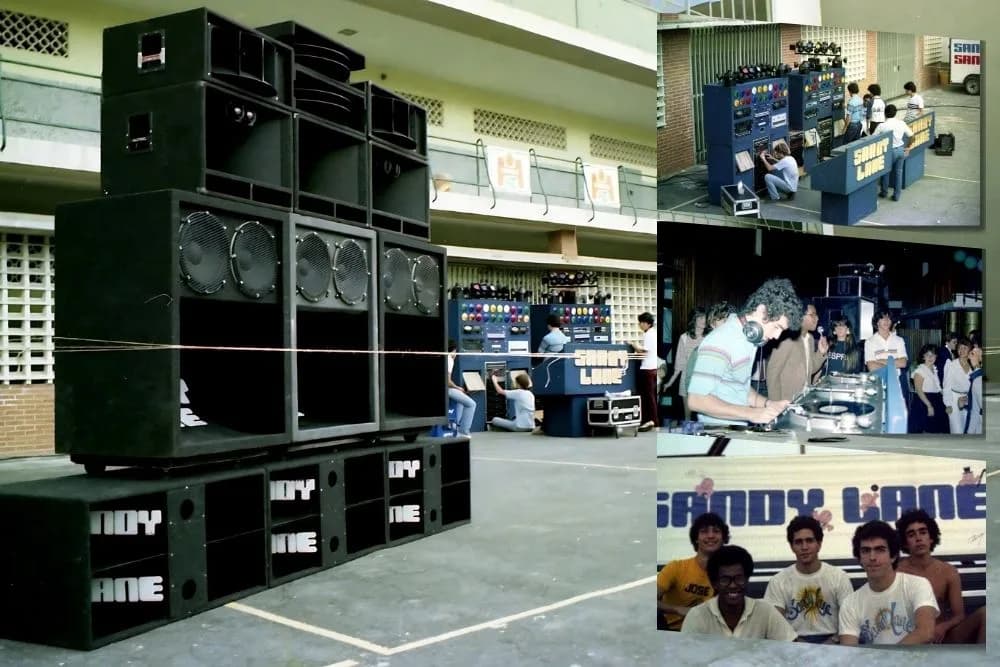
Main photograph: archive of culturaminiteka.com · Additional photos: archive of La Revista de las Minitecas (DJ Vladimir Medina)
◆ Miniteca · Mobile Power
Sandy Lane
La Consentida
One of the most remembered minitecas of the 1980s in Venezuela.
In search of the sound of Sandy Lane
We are working to track down genuine Sandy Lane sets in the best possible audio quality. If you keep a cassette, a mix or a jingle, share it through the contact form.
The origin
Its history begins in 1979, in a classroom of the Colegio San Ignacio de Loyola in Caracas, when Diego Manuel Rodríguez A. and Carlos Bóveda Z., still in their first year of secondary school, started as a game what would soon turn into a youth phenomenon. They were joined by Jorge Andrés Neher A. and José Manuel Gómez F., followed by José Antonio Maldonado B., Ramón A. Mantellini B., the host José Antonio “Tony” Escobar, and later on by José Lino Vaamonde S., of the Colegio La Salle La Colina.
Like any other miniteca, they began with a small cabinet and home equipment, playing parties at their friends' houses. They reinvested all the capital they had in equipment, birthday and Christmas presents included.
Each in their own post
At first everyone did everything, but the organization grew and the roles took shape. According to the account of its own members:
- · Charlie Bóveda — the miniteca's discjockey for more than seven years.
- · Diego Rodríguez — substitute discjockey and the man in charge of the lighting systems. He was the one who insisted until rock made it into the main repertoire of the musical selection.
- · Jorge Neher — the executive side: organizing, representing and managing the assets.
- · José Gómez — the chief utility man: transport coordinator, lighting technician, sound technician and discjockey whenever it was needed. His jeep and the trailer he found became indispensable assets.
- · José Antonio Maldonado — kept the equipment at his house when it no longer fit anywhere else, and designed and programmed the music for the second of the Sandy Lane minitecas.
- · Ramón Mantellini — the group's official photographer; with him the third of the minitecas was created.
- · José Lino Vaamonde — decided which equipment to bring in and optimized what they already had; the technical development of the sound and the lighting passed through his hands.
- · Tony Escobar — the host who represented the miniteca at the events, with his rapping and his dancing.
- · Pedro Paredes — for a long time in charge of moving the equipment, at the head of a large group of collaborators.
The sound: from the Altecs to the “toboganes”
The first serious speakers were a pair of Altec Lansing 1234s —the “voz del teatro”—, bought at Audio Especialistas, in the Centro Comercial La Florida. Soon after came the change that marked their history: the design of a set of cabinets with a rear element housing part of the sound and most of the lighting. That rear cabinet was imitated in every one of its versions the length and breadth of the country.
Chasing low end, they took up a JBL design, the 4520 with two 15-inch woofers: the remembered “toboganes,” named for the curve at the bottom. On José Lino Vaamonde's initiative they ended up keeping the six that Representaciones Crown, then JBL's distributor in the country, had imported. The first arrived gray and raw (4520BX); the next, black and with the logo on the sides (4520BK). Then came the 18-inch subwoofers.
The invoices that survive date that run and, in passing, portray the economy of the period: on March 4, 1982 they paid 3,906 bolívares for two toboganes; nine months later, the second pair cost 8,100, more than double. On May 19, 1982 they bought four JBL 2240H, the 18-inch drivers of the subwoofers, at 1,518 bolívares each.
The booth changed along with them: from an improvised mixer to the Citronic that lasted to the end, and from two Sony PS-70 turntables —which came to be three— to the Technics 1200 MKII. They processed with Urei: two monaural limiters, one per channel, a stereo compressor, third-octave equalizers and an electronic crossover they called “el taxímetro” for its digital display in red numerals.
Three minitecas at once
Sandy Lane was not a single rig. It came to run three minitecas at the same time: the second was designed and musically programmed by José Antonio Maldonado, and the third was born when Ramón Mantellini joined. At the patinatas of the Colegio San Ignacio de Loyola itself they went as far as rigging two at the same time.
Where they played
Sandy Lane played hundreds of events: fifteenth-birthday parties, verbenas and school patinatas —starting with those of its own Colegio San Ignacio de Loyola—, pro-graduación parties, weddings, birthdays and celebrations at clubs in Caracas and in the interior of the country. Fashion shows, commercial shoots and films as well. With the trips to the interior came the venues holding several thousand people: at first borrowing equipment and later sounding them on their own.
Among the stages its members document are the Domo Bolivariano in Barquisimeto —where on one occasion they shared the bill with Stereoteka and T-Connection—, San Cristóbal alongside New York New York, the Club de la Guardia Nacional in El Paraíso, the Concha Acústica de Bello Monte, the Hotel Intercontinental in Puerto Ordaz and the Camping Rincón Grande.
Of the Poliedro de Caracas they say they performed there on three occasions. The MiniTK Archive documents, so far, two bills carrying their name:
- · Explosión de Minitecas — Poliedro de Caracas, Friday, October 19, 1984, 7:30 p.m., to benefit the Fundación “Orfeón Universitario.” It shared the bill with Betelgeuse, New York-New York, Ambitus, Traffis, The Drop and Space Music. The result of that night is not on record.
- · Tercer Estallido Nacional de Minitecas — Centro Español de Puerto La Cruz, alongside New York New York, Betelgeuse, Empire, The Drop and Infierno, with Budgie representing the east of the country. The exact date is still to be documented.
The guerras de minitecas
They came early to the confrontations of the movement — the guerras de minitecas, the sound clashes of the era. Its own members report four of them:
- · Concha Acústica de Bello Monte, Caracas — alongside Traffic and New York People. In Traffic's booth, in its early days, was Manuel García: the same man who years later would mix the Sandy Lane record.
- · Concha Acústica de Bello Monte, Caracas — alongside New York New York.
- · Puerto La Cruz — alongside The Drop, Betelgeuse and New York New York.
- · Caracas — alongside Explosion People, Betelgeuse and New York New York.
1984: the peak of its development
By 1984 they had the most advanced professional audio and lighting there was. Among the brands in their equipment were JBL, Crest, Kremesa, Technics, Citronic, Teac (Tascam), Gauss, Crown, Urei, Audioarts, Cerwin Vega, Stanton, Altec Lansing, DOD, ElectroVoice, Times Square, Furman Sound, Anvil and Roadie.
José Lino Vaamonde's technical work was pioneering: they used real-time frequency analysis equipment to equalize each venue, with electronic crossovers and independent amplification for five-way speaker systems. Setting that up at every site, in an age without today's design conveniences, was a feat paid for —as they themselves tell it— by burning out speakers and a few eardrums.
In February of that year the miniteca changed hands: it was bought by the group behind Miniteca Betelgeuse, which had acquired The Drop in 1983 and was thus adding a third brand to its operation. With the purchase, Carlos Bóveda “Charly” joined the Betelgeuse crew. Sandy Lane went on playing under that ownership, and its 1986 record would carry the mix of Manuel García, Betelgeuse's discjockey.
Appearances on TV and in pop culture
Icons of the period: Club New York New York, Mister Ribs, the Tutti Frutti ice cream parlor, Salchistick, Bellocotón (Sra. Margarita Zingg de Blohm), the C.C.C.T. and the stylist Alejandro's.
- · Dimensión Humana (RCTV, 1984): special guests on Napoleón Bravo's program, broadcast on Fridays in the prime-time slot at 8:00 p.m. Created in 1982 to portray Venezuelan reality, the show devoted one installment to the youth world of the period, and into it went the miniteca, its people and its activities.
- · Radio Rochela (RCTV): taking part in a parody of the dance programs of the moment, inside the most watched comedy show on Venezuelan television.
- · Generación Halley (1986), by Thaelman Urgelles: a presence in the film that connected with young audiences at the height of Halley's comet fever, with Tony Escobar as guest artist and a soundtrack that brought together Karina, Melissa, Pablo Manavello, Frank Quintero, Guillermo Dávila and Aguilar.
The 1986 record
Sandy Lane made it to vinyl. After many recordings, meetings and projects, in 1986 a long-playing production came out with Sonográfica —an RCTV subsidiary— on the Atlas label (legal deposit nb-86-1343): fifteen italo disco and hi-NRG tracks chained together the way the miniteca sounded live, not as a list of separate songs.
The mix was signed by Manuel García Navas at the Estudio Fidelis C.A. in Caracas; the effects and edits, by Manuel García together with Tony Escobar; the sound engineer was José Mendoza and the general production, Alí Osse. The assembly was done with two Technics 1200 MKII turntables, an Efectron II, a DOD digital sampler and a Roland drum machine.
- · Side A — “Geil” (Bruce and Bongo) · “Last Summer” (Whiskey) · “Casablanca” (Andrea) · “Magic Fire” (Body Dancer) · “Mamma Radio” (Rudy and Co.) · “He Is the One” (George G.) · “New Beginning” (Bicks Fizz) · “Void Vission” (Cyber People).
- · Side B — “Destiny” (Time Roy) · “Secrets” (Albert One) · “Feel It” (Larabelle) · “Wind of Change” · “Gypsy and Queen” (Gypsy Queen) · “Venus” (Bananarama) · “Starstruck Lover” (Boiling Point).
In the media
The phenomenon reached the national press: reviews, articles and interviews about the minitecas and about Sandy Lane in particular, as well as radio programs and several television appearances.
Innovation and legacy
Between 1979 and 1986, Sandy Lane stood out for its sound, its music, its mixes, its cabinets, its lighting and its image, all developed at the start of the 80s. It was a byword for innovation, originality and respect, leaving a broad influence on the miniteca circuit and on the youth culture of Caracas.
«Over time, imitations and unauthorized uses of the name appeared. It is important to make clear that the members of the original Miniteca Sandy Lane bear no relation and no continuity to any present-day miniteca, club or event using its name, logo, cabinet design, jingles, tips, photographs or videos. The authentic history of Sandy Lane was born, unfolded and closed in the 80s, when its members turned to their studies, their professions and their families.»
Friends and collaborators
Sandy Lane's worth is also measured by the community that surrounded it. Among the friends and collaborators: Pedro Paredes S., Haik Gazarian, Juan Carlos, José Ignacio and Francisco Maldonado B., Carlos Calderas, Frank Phelan, Gabriel Vaamonde, Manuel L. Vásquez, the Macana brothers (Gustavo and José Andrés Díaz), the Silva-Díaz sisters (María Cristina, María Cecilia and María Mercedes), Beatriz E. Viso, the Castillo sisters (María Tatiana and María Cristina), Frances Brewer, Frances Maldonado, Yolanda de Neher, Cecilia Neher, Adriana and Alexa Gómez F., Daniela Borjas N., among many others.
A legacy of the 80s
Sandy Lane —fondly remembered as “Sandy Lane la consentida”— was an unrepeatable phenomenon of its time. Its legacy endures in the memory of those who lived through the golden era of the Venezuelan minitecas and in the influence it left on the musical and youth culture of a generation.
Social media
Credits and sources
- · History told by its original creators (official site minitecasandylane.com): the founding at the Colegio San Ignacio de Loyola, the roster of founders and collaborators, and the 1979-1986 stretch.
- · The role of each member, the three simultaneous minitecas and their technical development: section “Las personas” of minitecasandylane.com.
- · Equipment, brands and dated invoices —two JBL 4520 toboganes on March 4, 1982 for Bs. 3,906, the second pair nine months later for Bs. 8,100, and four JBL 2240H on May 19, 1982 at Bs. 1,518 each—, as well as the 1984 inventory of brands: section “Los equipos” of minitecasandylane.com, with the invoices reproduced.
- · Stages in the interior of the country, the four guerras de minitecas reported, the three performances at the Poliedro and the production of the record with Sonográfica, an RCTV subsidiary: section “Los eventos” of minitecasandylane.com.
- · The 1986 record —Atlas label, Distribuidora Sonográfica, legal deposit nb-86-1343—, its complete repertoire and its technical credits (mix by Manuel García Navas at the Estudio Fidelis C.A.; effects and edits by Manuel García and Tony Escobar; sound by José Mendoza; general production by Alí Osse; Technics 1200 MKII, Efectron II, DOD digital sampler and Roland drum machine): the sleeve and back cover of the record itself, reproduced on minitecasandylane.com.
- · Appearance on “Dimensión Humana” in 1984 and details of the program (RCTV, hosted by Napoleón Bravo, Fridays at 8:00 p.m., on air since 1982): minitecasandylane.com.
- · Participation in the “Explosión de Minitecas” of October 19, 1984 at the Poliedro de Caracas: the event's original general-admission ticket (ticket No. 06306, Bs. 40, to benefit the Fundación “Orfeón Universitario”) kept in the CMTK Archive.
- · Participation in the Tercer Estallido Nacional de Minitecas, at the Centro Español de Puerto La Cruz: entry in the collection “Classics at War” of the MiniTK Archive.
Were you part of the crew, or did you witness their setups? Help us document this story with verified facts and images.
Tell us and help improve this entrySource consulted on July 9, 2026
70s · 80s · 90s · Lighting · Minitecas · Rumbas · Sound