La imbatible en mezclas
Between 1983 and 1986, Hot Way perfected its proposition, with Ashley González as lead discjockey and a technical crew that knew how to bring in innovations in audio and lighting. The public began to identify it as “La Imbatible en Mezclas,” a hallmark that would stay with them in local and national competitions.
In that decade, they shared the stage with minitecas of great renown such as Hot Music, Saxon, Infierno, ZC, Sandy Lane and many more, establishing themselves as a benchmark of southeastern Venezuela.
Shows and tours
Hot Way took part in numerous national gatherings, touring stages in Puerto Ordaz, San Félix, Upata, Maturín, Anaco, Cantaura, Barcelona, Puerto La Cruz, Cumaná and Cumanacoa. Its reputation grew to the point of being recognized at festivals and guerras de minitecas —the sound clashes of the movement— as a rival on the level of the legends from the capital.
The spectacle included a dynamic mixing show, lighting effects bought from Super Efectos and a live emceeing proposition that set it apart in front of its audience.
The rig, from the inside
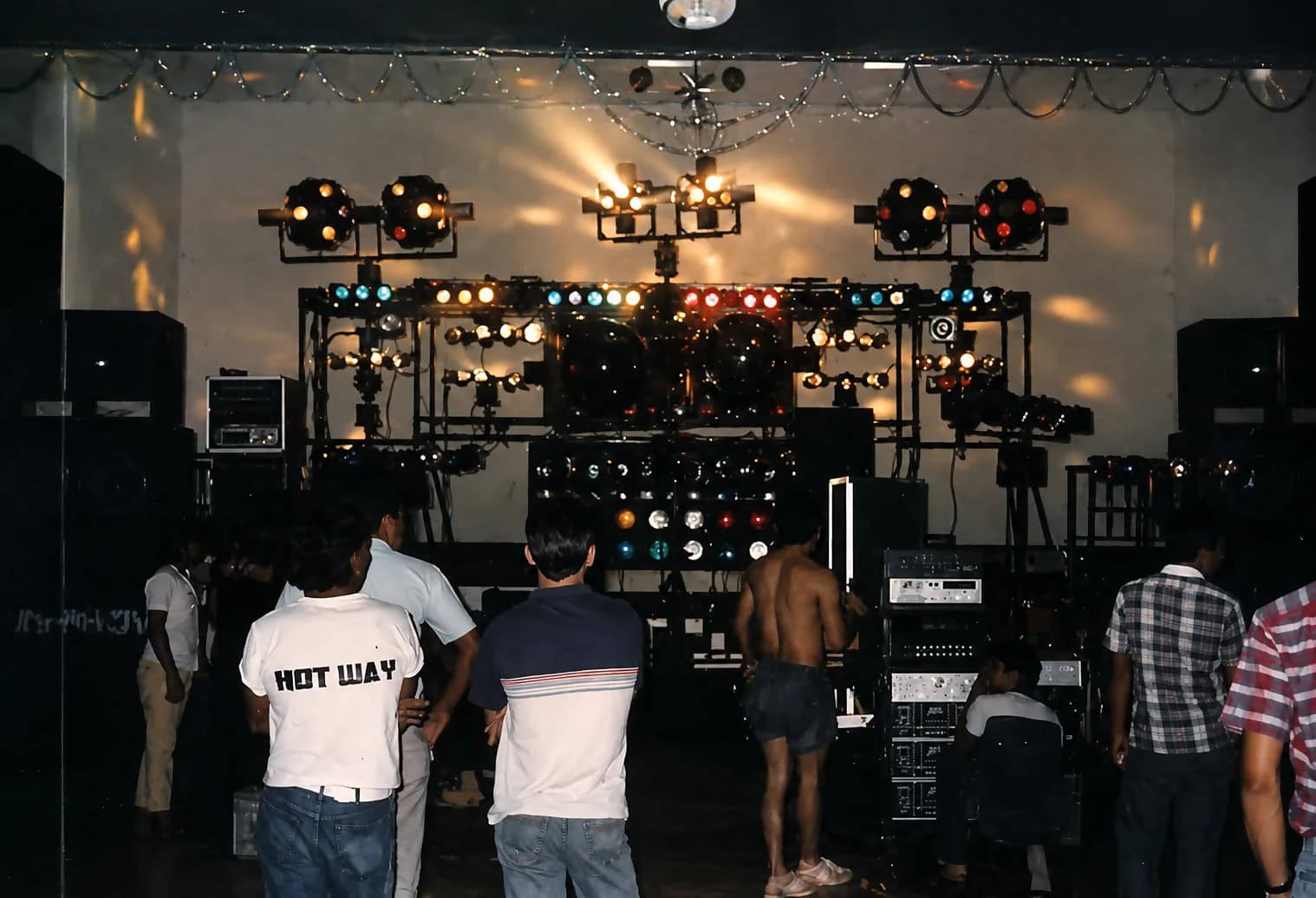
The archive photographs make it possible to see up close what that spectacle consisted of. The lighting was built on a metal structure leaned against the wall, loaded with dozens of colored lamps, with two large lens spheres —those black globes bristling with lamps— flanking the center and banks of floodlights on bars at the sides. In the stage rigs, those same spheres went up on tall tripods, so that the beam swept the ceiling and the dance floor at the same time.
The booth was a black front with the letters “HOT WAY” cut out in light-colored wood, and to its right the racks were stacked: amplifiers, equalizers and processors. Among them Peavey units can be made out, the brand with which —according to the account collected in this article— the crew started out with a 400 W power amplifier. The detail confirms in an image what the account maintains.
The rest is told by the surroundings: party halls in Ciudad Bolívar with hand-painted murals —a rainbow over green mountains—, garlands of bulbs on the ceiling and the crew working in T-shirts printed with the miniteca's name. No monumental stages: the power was in the wall of lights and in what came out of the speakers.
Legacy and impact
Hot Way stayed active for 17 years, until 1999, leaving an indelible legacy in the memory of Ciudad Bolívar and of Venezuela. It was a nursery for discjockeys and technicians, and a starting point for minitecas that took inspiration from its way of working.
Today it is remembered as one of the most emblematic minitecas of Guayana, one that proudly represented the region on the national scene.
Social media
- · Social media and contact: still being traced — do you have information? Write to us through the contact form
Credits and sources
- · Article based on the account of Ashley González, told and written by Daniel “DJ Danny” Salas, with contributions from La Revista de las Minitecas (DJ Vladimir Medina) and material gathered on social media.
- · Lighting rig, lettered booth, racks of Peavey amplifiers and Ciudad Bolívar halls: three archive photographs from the miniteca itself contributed to the CMTK Archive (primary evidence; they corroborate the Peavey power amplifier the account declares).
Were you part of the crew, or did you witness their setups? Help us document this story with verified facts and images.
Tell us and help improve this entry