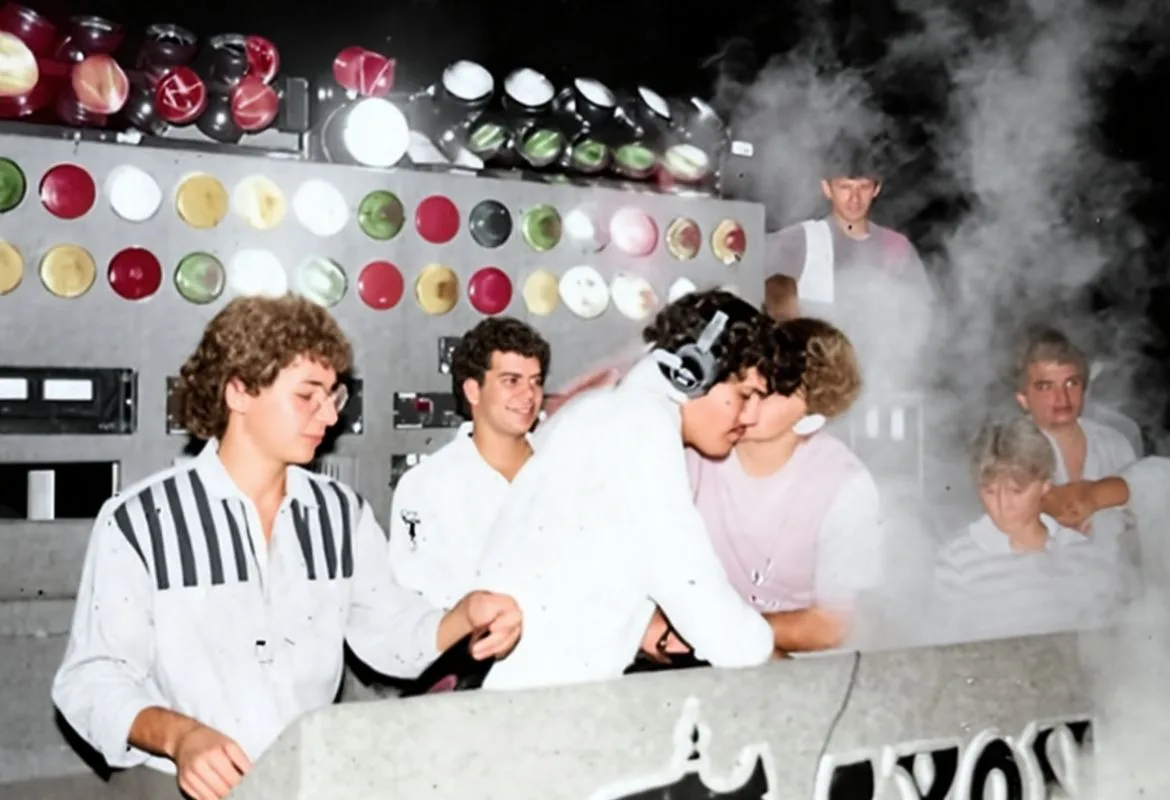
They took the concept from Sandy Lane, which Marquez had seen on television. He had the booth cabinet made himself and lined it by hand; the name and the logo they took from a record by the British band Saxon, cutting them out of construction material and painting them. That emblem is the one still recognizable in every photograph of the crew.
The sound and the lights
Saxon was, above all, a sound rig that kept growing over time. According to Marquez —its technical lead—, they started out with Peavey gear and ended up working with Renkus-Heinz and RCF: 18-inch subwoofers, scoop bins, mids and highs, with amplification that went from the Peavey CS800s to Crowns. The lighting was original Kremesa —rotating spider lights with their controllers and a smoke machine. The big investment was made by the Gaspar brothers' father, who brought in the Kremesa and the Crowns; and one of the sponsors was Alfredo Gouveia, the owner of a bakery, who answered for whatever broke and for the heavy investments.
According to Henry Gaspard himself —Saxon's co-founder—, the crew's sound was under his direct responsibility and that of his younger brother, Jean Paul Gaspard, today the director of Audio Concept.
The night at the Poliedro
Saxon's big outing beyond Guayana was at the Poliedro de Caracas: a friendly gathering of minitecas organized by Johnny Cabrera, the president of Betelgeuse. The date is estimated at 1984 and is still being traced — it may have fallen between 1984 and 1986.
On the bill were T-Connection and Cerebro, among others: both stand out in the archive photograph of that night, with Saxon and T-Connection in the foreground and Cerebro's cabinet to the left of the booth, seen from the discjockey looking out toward the crowd.
The crew went on worried: the account of Leonardo “Cara de Perro” Marquez tells that they did not know how the Caracas crowd would react to their calling card — opening with rock, with “Princess of the Night” by Saxon, the band that gave them their name. The response was a frenzy: with Amílcar Pino running the MK2 turntables, the miniteca came away with an ovation. And, according to that same account, Saxon remains the only miniteca from the state of Bolívar to have performed at the Poliedro de Caracas.
“La Revista de las Minitecas” recorded that appearance as a guerra de minitecas —the sound clashes of the movement—, with Saxon taking third place. Marquez's direct account, gathered by this Archive, pins it down as a friendly gathering, with no competition involved.
Appearances and recognition
On home ground, Saxon took part in guerras de minitecas in Ciudad Bolívar and Puerto Ordaz, measuring itself against the most relevant crews in the state: Roseland, Hot Music and Hot Way, among others.
It also matched its sound against Scooby Doo. It won many local festivals and sound clashes, leaving its mark with its sets and its staging.
In 1986, Saxon was one of the twelve minitecas on the compilation LP “Invasión de Minitecas” (Magic Record's), with its mix of “Tonight (Dancing With The Desperate),” alongside T. Connection, Soultrain, Magique, Kisses Acetato's, Cerebro and six other crews from around the country.
Discjockeys and standout members
Its first booth was led by Amílcar Pino. Some time later Jorge “Manota” Pacheco (today known as DJ Voodoo) and Ely Contreras joined, and they helped keep its proposal alive.
From Saxon to Audio Concept
Over the years, the original Saxon went to Caracas and did not come back. According to Marquez, it did not disappear: it mutated. “Saxon did not die, it mutated,” he sums up. That Guayana miniteca was the seed of Audio Concept, today one of the most important sound, lighting and video houses in the country —founded in 1988, based in Margarita and Caracas and with a presence in Colombia and Panama—, run by Jean Paul Gaspard, one of the founding brothers, and the distributor of the RCF brand Saxon ended up working with. The last rig of the original Saxon, Marquez recounts, was at Jean Paul's wedding.
Saxon left an indelible mark on Guayana: those who lived through its shows still remember it fondly. Its style, its sound and its attitude were part of the golden age of the minitecas — and its story carried on, transformed, inside the Venezuelan sound industry.
Credits and sources
- · This article is based on what was published in La Revista de las Minitecas (DJ Vladimir Medina) and on accounts gathered from the Guayana community.
- · First-hand account by Leonardo “Cara de Perro” Marquez to Culturaminiteka.com (voice notes, October 2025; transcribed and synthesized by the CMTK Archive): the origin of Saxon from the joining of the Colegio Loyola and Villa Alianza groups; the authorship of the cabinet, of the logo (taken from a record by the band Saxon) and of the sound; the equipment (Peavey, Renkus-Heinz, RCF, Crown; Kremesa lighting); one of its sponsors, Alfredo Gouveia; and its transformation into Audio Concept. See his entry in “Hidden Figures.”
- · Account by Leonardo “Cara de Perro” Marquez to the CMTK team (August 2026): the appearance at the Poliedro de Caracas as a friendly gathering organized by Johnny Cabrera (Betelgeuse), around 1984 (date pending verification); the opening with “Princess of the Night,” Amílcar Pino's mixing on the MK IIs and the ovation; and the identification of the photographs in the gallery (the rigging of the cabinet, the move and the van, with Alfredo Gouveia and Eli Rendón).
- · Identification of the archive photograph of that night (second image in the gallery): T-Connection and Saxon in the foreground, and Cerebro's cabinet to the left of the booth, seen from the discjockey looking out toward the crowd — with no evidence that Betelgeuse or Sandy Lane were there that night.
- · “La Revista de las Minitecas” (DJ Vladimir Medina edition), p. 41: records Saxon's participation at the Poliedro as a guerra, with third place — a version that differs from Marquez's direct account (see the note in “The night at the Poliedro”).
- · External corroboration of the outcome: Audio Concept, C.A. (sound, lighting and video; founded in 1988; based in Los Robles/Porlamar, Isla Margarita, and Caracas; CEO Jean Paul Gaspard; distributor of RCF) — LatamStage, Instagram @audioconcept_ve and business directories. The Saxon→Audio Concept link comes from Marquez's account.
- · Direct account by Henry Gaspard, Saxon's co-founder, to the CMTK team (August 2026): his own responsibility, and that of his younger brother Jean Paul Gaspard, over the crew's sound.
- · Saxon's inclusion on the LP “Invasión de Minitecas” (Magic Record's, 1986, legal deposit nb-86-2314): this Archive's entry for the record, with data from Discogs (release 2623719) and cover art digitized by the Melómano Incurable archive.
Were you part of the crew, or did you witness their setups? Help us document this story with verified facts and images.
Tell us and help improve this entry