The name had a curious origin: “Banana Power inc.” came from a supposed Brazilian discotheque that someone mentioned to Franklin “Kofla” Zambrano back in 1979, when he was still in high school.
From Banana Power to MK II
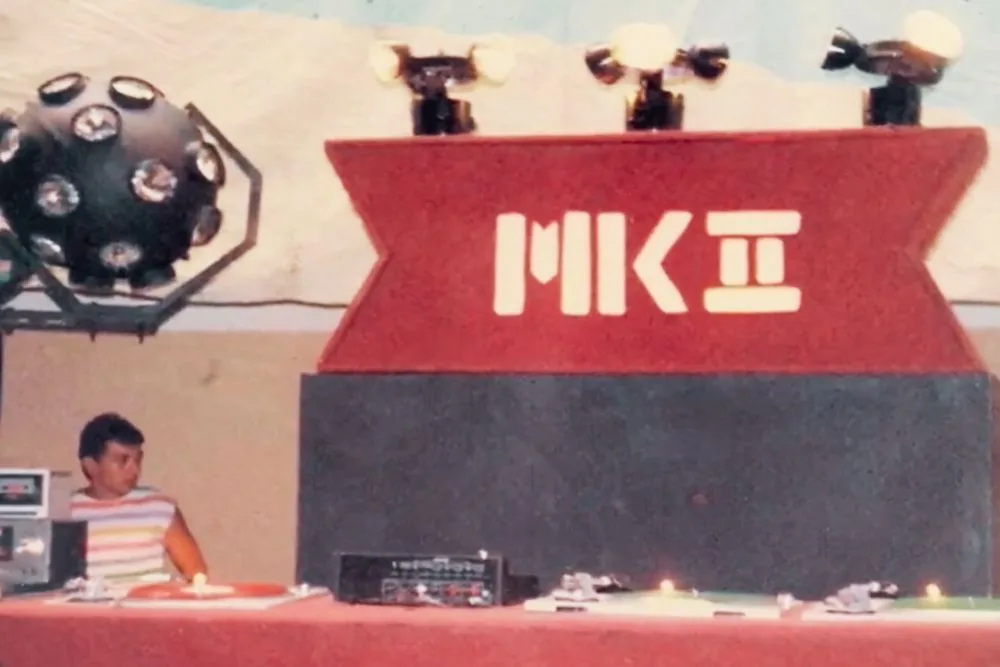
In 1985, the miniteca changed its name to MK II, to fit the style of naming that prevailed at the time. For the debut of the new identity they took advantage of an invitation to an event at the Complejo Naciones Unidas in Caracas, where it shared the stage with ZC, Les Gamin's, Nasty, Green Line and one or two others.
Its performance was the standout of the night: Jairo, the official discjockey, put together a disco set that carried the crowd along and had it dancing and shouting with euphoria. That show also marked the debut of a new cabinet: a backing full of lights that gave the miniteca a very particular touch of charm.
Between homemade and professional
Like so many others, Banana Power inc. started out with home equipment —except for the turntables—. From before its beginnings it had two Technics 1200 MkII, a Numark 1800 mixer for three turntables and a Numark 1500 mixer. Among the early gear people remember a curious “souped-up” Sansui turntable, whose pitch reached a higher speed than the Technics themselves, as well as Sansui amplifiers and deck and JBL and Bohem speakers.
The lighting was the typical kit of the period: traffic-light units, strobes and cocteleras. In time professional gear was acquired and the lighting inventory grew, with home-built moving lights added to others made nationally and imported. The first official party with a custom cabinet was in mid-1983, at the birthday of partner Pasquale Pascuariello, in a hall on Avenida México; the first formal contract was a fifteenth-birthday party in the function room of the Nuestra Señora de Pompei church.
The booth and the voices
MK II had few discjockeys over the course of its run, since the partners themselves also filled that role. The most prominent were Jairo Fernández —on changa, new wave and rock— and Franklin “Kofla” Zambrano —on Latin music and the hora loca—. Later Juan Carlos “Platanito” Blanco joined the staff, and partner Francisco Armas also made good contributions spinning records from time to time.
Banana Power inc.'s jingles were made by Alejandro Rhode in his early days in radio; with the change of name to MK II they moved to the voice of Enrique Hoffman. As sponsors, MK II had the station Tropical 99.0 and Disco Oído Musical.
A miniteca for a select audience
Banana Power inc. and MK II were minitecas aimed at a very select audience: most of their parties were private —weddings, fifteenth-birthday parties, pre-graduations and graduations—. Even so, they took part in several mass events: the UCV music festivals, where they alternated with groups of the stature of Gran Coquivacoa, Grupo Mango, Fósforo and José Rosario y su sonero; two events at the Complejo Naciones Unidas in Caracas; and a guerra de minitecas —the sound clashes of the movement— in Los Teques.
Although MK II never traveled outside Venezuela, it did tour a good part of the country's interior. Its most remembered engagement was the Caripe carnival of 1986, where it played for four days: parades every afternoon and a night-time party in different locations around the town.
The “mkdoceros”
The miniteca's greatest thanks always went to those who helped selflessly and without any pay: first of all, the partners' parents and families, for their patience —above all when the equipment was still stored at home—. To them was added the enthusiastic troop of the “mkdoceros.”
Alexander “Corotero” Solano, David Armas, “Pipo” and “Pepe” Moncayo, José Luis “Cabezón” Arias, Rafael “For You” Estrada, Eudin Duque, Aldrin Dacunha, Carlos “Pajarito” Ferreira, Mauro Gamboa, Luis Miguel “Xoopa” Santos, Juan Pablo “Juanpi,” Alejandro “Mechón” Vélez, Domingo “Mechón 2” Gutiérrez, Alix Honoré Roger, Lony Ortega, the girls of the Jardín del Centro, the Gallegos Escobar family and the colleagues and friends of ZC, Laser, Control Shout, Maui and West End, among many others.
The curtain, in low profile
In time, MK II slowed down. According to the account of its protagonists, the miniteca “does not leave the stage” and is still going, though in low profile. Its original owners' decision to sell it came down to a very human reason: the commitments and the activities the miniteca demanded could no longer be met properly, since they were all university students in their graduating years, about to begin their professional lives.
Credits and sources
- · Article based on the account of its protagonists collected in La Revista de las Minitecas (DJ Vladimir Medina edition).
- · Pending documentary verification: the exact dates of each event, the full equipment models, the definitive roll of partners and collaborators, and the existence of current official social media or contacts.
Were you part of the crew, or did you witness their setups? Help us document this story with verified facts and images.
Tell us and help improve this entry