Culture
The word that made it into the dictionary
“Miniteca” is in the Diccionario de la lengua española, and it says more than it seems
By CulturaMiniteka editorial desk ·
A young man from Caracas joined the prefix “mini” to the ending of “discoteca” to name what he had just invented. That word today has an entry of its own in the Diccionario de la lengua española, with two senses and the label “Ven.” — and it has been there longer than almost anyone remembers. It is not a charming detail: it is the hardest-to-erase recognition the movement has won.

The entry, exactly as it stands
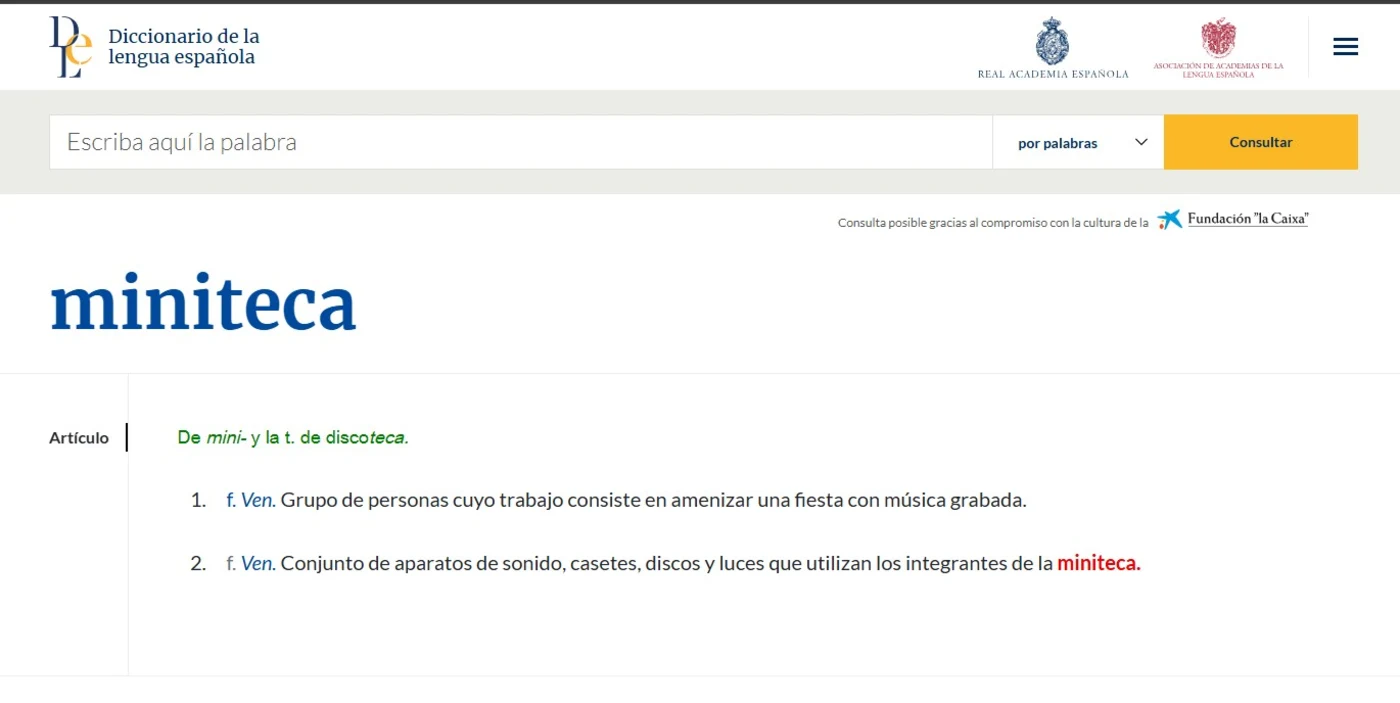
The Diccionario de la lengua española —the work published jointly by the Real Academia Española and the twenty-three academies of the Asociación de Academias de la Lengua Española— records the word like this:
- Etymology: “De mini- y la t. de discoteca” (“from mini- and the ending of discoteca”).
- 1. f. Ven. Grupo de personas cuyo trabajo consiste en amenizar una fiesta con música grabada. (“A group of people whose work consists of enlivening a party with recorded music.”)
- 2. f. Ven. Conjunto de aparatos de sonido, casetes, discos y luces que utilizan los integrantes de la miniteca. (“The set of sound equipment, cassettes, records and lights used by the members of the miniteca.”)
«The first sense does not talk about equipment: it talks about people. The dictionary understood, before many did, that a miniteca was above all a group of human beings.»
What that entry says without saying it
It is worth reading it slowly, because every line holds a decision.
The etymology does not say “de mini y discoteca”: it says “de mini- y la t. de discoteca”. That “t.” is “terminación”, the ending. That is, the word was not formed by gluing two whole words together, but by taking the prefix of size and keeping only the ending of the other one —the part that in Greek means “store”, “a place where something is kept”, the same one in biblioteca or hemeroteca—. Whoever invented it was not saying “discoteca pequeña” (“small discotheque”). He was saying something else: a portable archive of music.
The label “Ven.” means venezolanismo, a word of Venezuelan origin. In a dictionary written between twenty-four academies, that abbreviation is a birth certificate: it certifies where the word came from.
And then there is the order of the senses, which is the most revealing part. The first does not talk about equipment: it talks about a group of people. The gear appears in the second, and is defined by reference to the first — “los aparatos que utilizan los integrantes de la miniteca”, the equipment used by the members of the miniteca. The dictionary understood, before many did, that the miniteca was the people and then the gear.
There is even a detail that dates the definition without meaning to: among the equipment are cassettes. The entry was fixed in a specific era, and that involuntary snapshot is heritage too.
When did it get in? It was not in 2014
One date circulates with great insistence: 16 October 2014, with the twenty-third edition of the dictionary, the tercentenary one. It is false, and it can be checked in the Academy's own house.
The Real Academia keeps online the complete text of the twenty-second edition, the one printed in 2001. There, thirteen years ahead of the date that gets repeated, it already is:
“miniteca. 1. f. Ven. Grupo de personas cuyo trabajo consiste en amenizar con música grabada una fiesta. 2. f. Ven. Conjunto de aparatos de sonido, casetes, discos y luces que utilizan los integrantes de la miniteca”.
That is: the word had already spent a quarter of a century inside the dictionary. And it did not tiptoe in — it went in whole, with its two senses and with the Venezuelan label.
Comparing that entry with today's shows what changed over these years, and it is not little: the 2001 edition carried no etymology. The explanation of how the word was formed —“De mini- y la t. de discoteca”— was added later. The Academy first recorded that the word existed; only later did it explain where it came from.
And there is a second entry, with one sense more
The Diccionario de la lengua española is not the only place where the word has a seat. The Diccionario de americanismos, also published by the Asociación de Academias de la Lengua Española, records it labeled for two countries: Venezuela and Colombia.
And it adds a third sense that the DLE does not have, labeled for Colombia only: the miniteca as the party itself — “fiesta juvenil en la que se baila y utilizan todos los elementos de la miniteca” (“a young people's party where there is dancing and all the elements of the miniteca are used”).
It is a small detail and it says a lot. The word did not stop at the border: it crossed, and in crossing it changed meaning. In Venezuela the miniteca is whoever puts on the music and the gear they put it on with; in Colombia it came to be the whole night as well.
How a word gets into the dictionary
A mistaken idea is worth taking apart: you do not get into the dictionary by popular vote or by insistence. You get in through evidence. The Academy does not decide which words ought to exist — it documents which ones already do.
Four criteria are applied, and a word has to meet all of them:
- Real and continued use: that real people speak it, not that someone invented it a short while ago.
- Geographical spread: that it is used across a broad territory — a whole country or several regions of the Spanish-speaking world.
- Frequency: that it appears again and again in speech, in the media, in books.
- Permanence: that the use holds up over time and is not a seasonal fad.
To measure it they do not trust the ear. The Academy combs enormous corpora of texts —the CORPES XXI gathers hundreds of millions of words of contemporary Spanish— and there you can see, in black and white, how many times a term appears, in which countries and for how long. Afterward, committees of philologists and lexicographers define the exact meaning and establish the etymology.
And there is the step that gets ignored the most: the Diccionario is not written by the RAE alone. It is a pan-Hispanic work. The proposal is sent to the twenty-three academies of the Asociación de Academias de la Lengua Española —among them the Academia Venezolana de la Lengua— so that they confirm whether it is used in their countries and how. Only then does the plenary of academicians vote on the inclusion.
There is also a door open to the public: in 2011 the RAE created the Unidad Interactiva del Diccionario, precisely to receive proposals and suggestions from outside the academies.
Put that way, the size of what happened becomes clear. “Miniteca” did not get in out of sympathy or because somebody pushed it hard: it got in because there were thousands of parties, decades of use, a whole country saying it and a neighbor —Colombia— that had adopted it. What was documented before the Academy was not a word. It was a phenomenon.
Who pushed it: what we know and what we do not
Here it is worth being exact, because two different milestones of the same story get mixed up.
Who coined the word is documented: Víctor Morín, in January 1967, when he named his project Los Muertos Andantes and used the prefix “mini” to describe a reduced version of the Caracas discotheques that had dazzled him.
Who handled the official recognition is another matter, and it came much later. The Miniteca New York New York —“La New York”, founded in 1980 and remembered for bringing the professional club format to events— publicly claims that effort: its organization tells on its own channels that it coordinated the documentation campaign to get the term into the dictionary, following the guidelines of the RAE and of the Asociación de Academias.
In those same statements it thanks those who contributed testimony and documentation about how a miniteca was born and technically operated in the seventies, eighties and nineties: Guillermo “Memo” Rodríguez, director and one of the heads of sound and production of the crew; the announcer Henry White, who has an entry of his own in this Archive; and the discjockeys Tony “The DJ”, Gabriel Manzano and Carlos Parra.
And here it falls to say what we do not have, because the nuance matters: **the one asserting the effort is the interested party itself**. We have not located any independent source —a press item, a communication from the Academia Venezolana de la Lengua, an academic file— that documents it from outside. That does not disprove it at all: it is normal for whoever carries out an effort to be the one who tells it. But it is a claim, not a record.
Very little would be enough to settle it: a letter, a press clipping from the time, the Academy's reply, the date the proposal was submitted. If anyone still keeps any of that, it is one of the most valuable pieces this Archive is missing.
And there is one fact that narrows the search a great deal: if the word was already in the 2001 edition, any effort that carried it there had to happen in the nineties, not in 2014. That rules out a good part of what gets told and, at the same time, says where the paper has to be looked for.
Why it matters more than it seems
Gear gets sold, cabinets get taken apart, acetates get scratched and parties are forgotten. Of almost everything that made this movement great, what is left today is a faded photograph or a testimony.
The word does not. The word is in the dictionary the whole language consults, and there it will remain when not one of those speakers is left. It is the least perishable monument miniteca culture achieved — and it was raised, without their knowing it, by some kids who only wanted to get their neighborhood dancing.
In pictures
AN ILLUSTRATED RE-CREATION, not a photograph. The scene does not document a real ceremony and does not portray specific people: it is a symbolic representation of the effort New York New York claims to have made before the Academy. The T-shirt logo is the crew's own, reproduced from an original contributed to the CMTK Archive.
Links
Sources
- · “Miniteca” entry of the Diccionario de la lengua española (RAE-ASALE), dle.rae.es/miniteca — etymology, “Ven.” label and its two senses, transcribed literally. Accessed 4 August 2026; screen capture kept in the CMTK Archive. Primary source.
- · “Miniteca” entry of the Diccionario de americanismos (ASALE), asale.org/damer/miniteca — labeled for Colombia and Venezuela, with a third sense (“fiesta juvenil en la que se baila y utilizan todos los elementos de la miniteca”) recorded for Colombia only. Accessed 4 August 2026. Primary source.
- · Criteria for incorporation (real and continued use, geographical spread, frequency and permanence), searches in academic corpora such as the CORPES XXI, consultation of the twenty-three ASALE academies and the vote of the plenary: Real Academia Española, rae.es.
- · Unidad Interactiva del Diccionario, created in 2011 to receive external proposals and suggestions on the Diccionario: Real Academia Española.
- · Coining of the term by Víctor Morín in January 1967 with Los Muertos Andantes: MiniTK Archive entry.
- · Effort toward academic recognition: publicly claimed by the Miniteca New York New York's own organization on its official channels (@newyorknewyork_oficial), where it credits Guillermo “Memo” Rodríguez, Henry White, Tony “The DJ”, Gabriel Manzano and Carlos Parra. It is the interested party that asserts it; NO independent source documenting it has been located, and the article states so.
- · Presence of “miniteca” in the 22nd edition of the Diccionario (2001), with its two senses and the “Ven.” label, and WITHOUT etymology: electronic version that the RAE itself keeps online, rae.es/drae2001/miniteca. Accessed 4 August 2026. Primary source — it disproves the 2014 date in circulation.
- · ⚠️ Discarded as backing: the article “De profesiones, oficios y algunos estereotipos de género que perviven en el diccionario académico” (revista Letras, UPEL), often cited to date the incorporation to 2014: the full text was consulted and the word “miniteca” does not appear in it.
Minitecas · Venezuela · Language · RAE · Heritage · History